
A medieval mom

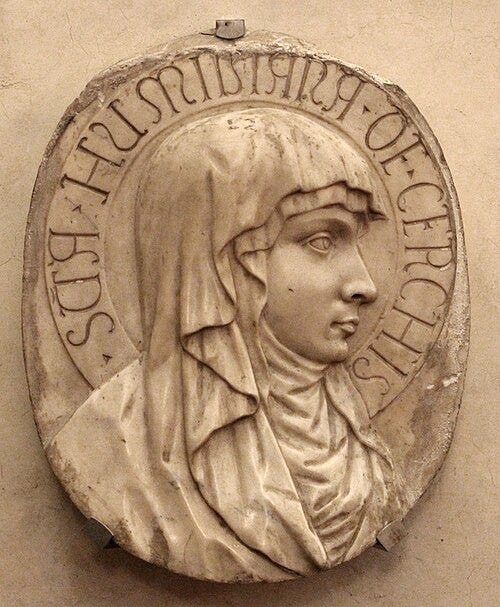
Here in the US we’re just a few days past Mother’s Day, a day for celebrating mothers with cards and gifts and dinners out. So I thought I would focus on a medieval mother for this post. While several came to mind, I chose to talk about a 13th century Florentine who was beatified after her death in 1246.
The Blessed Umiliana de’ Cerchi, speaking of her children:
O how blessed they would be if they were to die so unstained, still bearing their virginity. If it is God’s will, I would prefer that they die and go to glory rather than live, lest at some time they offend God and so lose a portion of the eternal inheritance. - quoted in Carol Lansing’s book The Florentine Magnates
Umiliana’s daughter Regale (imagined response):
Um... Mom?
Have you ever heard anyone say, “My mother is a saint”? It’s just possible that might not be an entirely good thing, from a child’s point of view.
So who was this lady? Umiliana (aka Humiliana, Emiliana) was born around 1219, into a wealthy Florentine family. The Cerchi were bankers, influential in Florentine politics and becoming ever more so. They were to become the archenemies of the Donati clan.
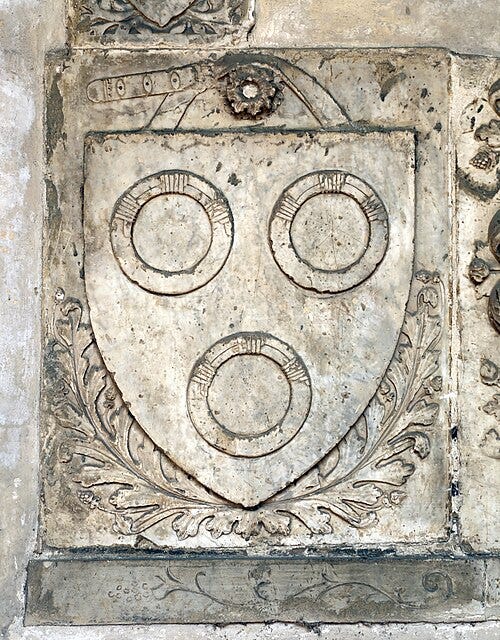


At sixteen, Umiliana married a member of the Buonaguisi family. Shortly after her marriage, and probably under the influence of her sister-in-law Ravenna, she rejected “the pomp and adornment of the world.” She would not paint her face. She cut off the bottom of a beautiful new tunic her husband had given her, made sleeves out of the cloth, and sold them, giving the money to the poor. She collected her old clothes and her husband’s and gave those to the poor, and when she had cloth to make sheets, she made them shorter than usual and gave the rest of the cloth away.
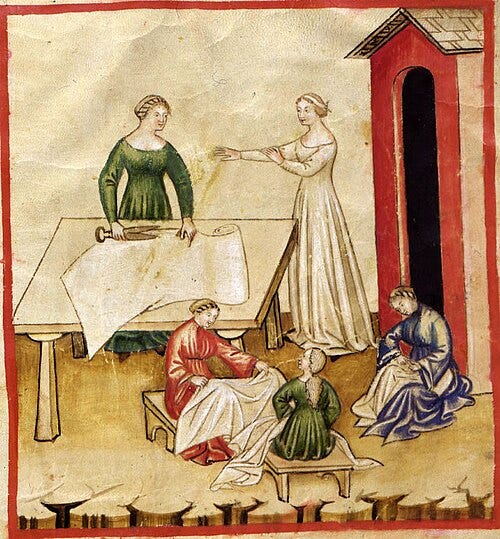
She also gave away “all the linen which she found in her husband’s chamber.” I don’t know whether that meant bed linens only, or if she also gave away the unfortunate man’s shirts and underwear. She even removed feathers from the marital mattress, to make a pallet to give to a hospital.
She “took the food out of her mouth, reseasoned it, and gave it to the poor.” She stayed up late at night to prepare food for the poor, which she and Ravenna would distribute the next day, bringing along servants to help carry it all.
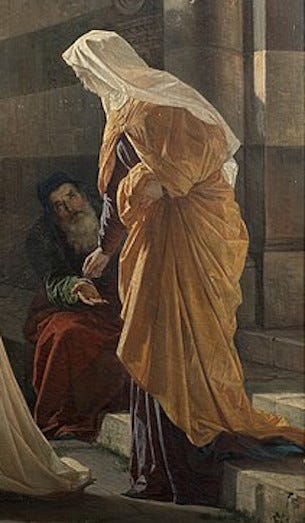
Needless to say, her husband and his family were not gruntled about all of this. At least the male members of the family were not; Umiliana seems to have had a wonderful rapport with their womenfolk, many of whom testified to her sanctity after her death.
As Umiliana’s biographer, Fra Vito of Cortona, tells it, her husband and his male relatives (and later her own male relatives) opposed her efforts every step of the way.
But can you blame her husband? His young trophy wife is running around in unfashionably short clothes; she’s giving away his underwear, stoking the cookfire and cooking all night, and his bed is short-sheeted and missing a lot of feathers. This was probably not what he bargained for. As one historian said, “Umiliana did not so much reject marriage as subvert it.”
Umiliana as a mother
Her husband died after a few years of marriage and the birth of two daughters. Umiliana spent the next year in her husband’s home, increasing her charitable efforts, much to the displeasure of her husband’s brothers. Then she moved back to her father’s house.
Her children stayed behind. Medieval Florentine society believed that’s where they belonged as part of their father’s lineage.
Did Umiliana have any choice in the matter? Some men made provision in their wills for their widows to stay in the family home with their children as long as they remained chaste, but we don’t know if that happened in Umiliana’s case. Did her husband’s family become exasperated and order her out (fearing, perhaps, for their underwear)? Did she choose to leave? Did her father, who wanted to use her in another dynastic marriage, insist?
We don’t know. We do know she left the girls behind, probably in the care of her beloved sister-in-law Ravenna. We know that members of her birth family tried in vain to persuade her to marry again. We know that she wanted to enter a convent of Poor Clares at Monticelli, but when she was not accepted, she took up residence in a cell in her father’s tower and continued her charitable efforts as a Franciscan tertiary from there.
We also know that Umiliana’s father, Oliviero (Vieri) dei Cerchi, reclaimed the right to her dowry, which she claimed he did by deceiving her so that now she would live in her father’s home “as a servant, not as a daughter.” This severely limited how much she could give away to the poor. Lack of dowry may also have been why she was rejected by the convent—while the Poor Clares espoused poverty, the fact remained that most of the nuns in that Florentine religious house were from wealthy and powerful families, and entered with a dowry.
Umiliana did love children. She had visions of the Christ child; she once tried to capture the Holy Spirit in the form of a dove to give to her little nephew; she visited a sick boy and voluntarily took his suffering upon herself.
It is said that a demon tried to tempt her out of a vow of silence by showing her visions of various kin lying dead, which would require her to mourn them aloud, and that one such vision was of her two daughters lying on a pallet at her feet, but she successfully resisted this temptation.
And one telling incident: her daughter Regale was visiting Umiliana in her tower room one day shortly after terce (mid-morning) when the child was suddenly struck dumb, and then fell down as if dead, turning very white. Umiliana, distraught, tried to revive her, but perceiving no breath, she believed her daughter had died. Fra Vito tells us she feared the trouble this would bring down on her head when her husband’s relatives learned of it (emphasis mine), so she prayed to an image of the Virgin. Then a beautiful child appeared and made the sign of the cross over the little girl, who sat up, now fully conscious and completely well.
Rudolph Bell, in his book Holy Anorexia, claims that Umiliana’s inlaws believed she was not a fit mother. Yet they did permit the child to visit her—unless that was done solely on Ravenna’s initiative, which seems possible. As we have seen, leaving the girls with her husband’s family may well not have been Umiliana’s choice.
Was she as lacking in human feeling for her daughters as some of these quotes and anecdotes seem to suggest? I wouldn’t be too sure. Everything we read is filtered through her Franciscan biographer, who was trying to depict the life of an urban Franciscan tertiary as he saw it, in the early days for the Franciscan order.
At the hearings about her sanctity she was supported not only by three Franciscan friars, but also by 30 women, many of them members of her own or her husband’s family. I find it hard to believe they would have testified for her if they had seen her as an inadequate mother. Once again we are peering far into the past, without much information to work with, and it is not wise to judge people of another time by the standards of our own.
We do not know what eventually became of Regale and her sister.
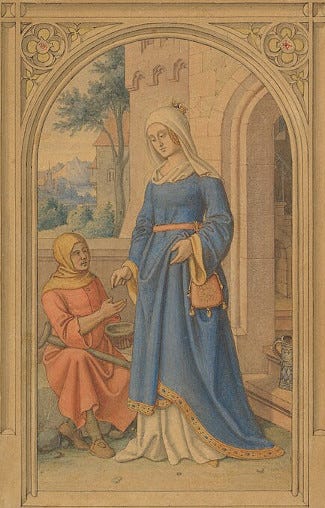
As always, thank you for reading Medieval Italian People, and I’ll be back with more on the ides of May (that’s the15th). Until then, I wish you a delightful spring and lots of good reading.
So interesting!