
Beatrice

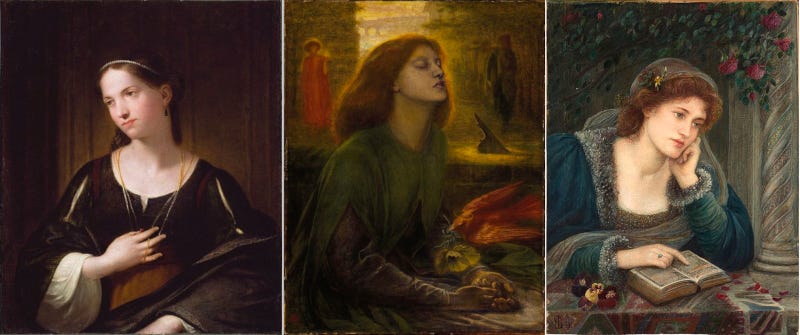
Let’s take a look at the historical woman who we now know as Dante’s literary immortal beloved, Beatrice. It often feels to me like when I try to discuss an individual, most of what I’m telling you is what we don’t know, and Beatrice is no exception.
It is generally—though not universally—assumed that the historical Beatrice was the daughter of the eminent Florentine banker Folco Portinari. It was Giovanni Boccaccio, in his commentary on Dante’s Divine Comedy, who identified her by name.
Her father, Folco Portinari, was wealthy and influential, holding high office in the Florentine government on several occasions. He founded the hospital of Santa Maria Nuova, which is still operating today. That’s about seven and a half centuries of continuous service—not a bad legacy.
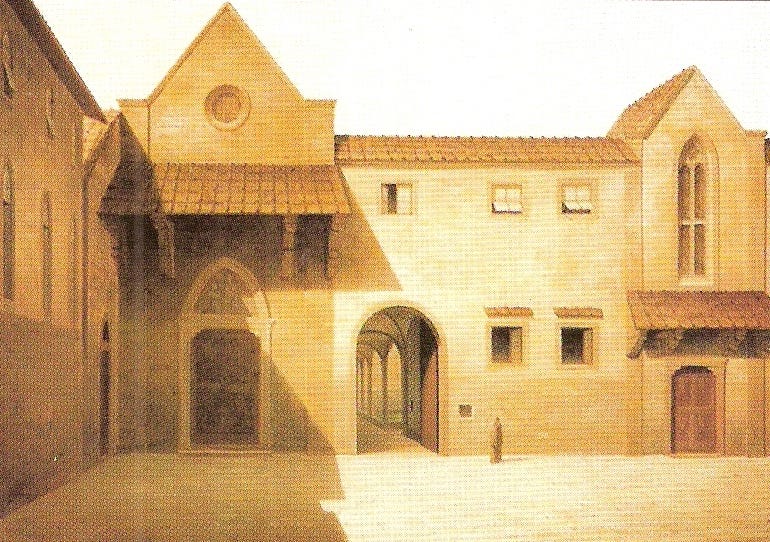
What exactly do we know about this woman? Dante gave her a starring role in the Commedia, and years before that he compiled a little book of his youthful love poetry, telling us something of his life as a young man in Florence, and of his love for Beatrice. Drawing on that book (the Vita Nuova), Boccaccio, tradition, and Folco Portinari’s last will and testament, here’s what we know:
Beatrice was usually called Bice (pronounced BEE-chay, rhymes with eBay). She was one of eleven children born to Folco and his wife Cilia Caponsacchi, so it’s a good thing he was rich: six daughters (Ravegnana, Bice, Vanna, Fia, Margarita, and Castoria) and five sons (Manetto, Ricovero, Pigello, Gherardo, and Iacopo). As we know from Folco’s will, at the time of his death at the end of 1289 Ravegnana was the mother of a child and possibly already deceased; Bice was married; and two of his sons were legal adults. One, Manetto, was Dante’s second best friend, right behind Guido Cavalcanti.
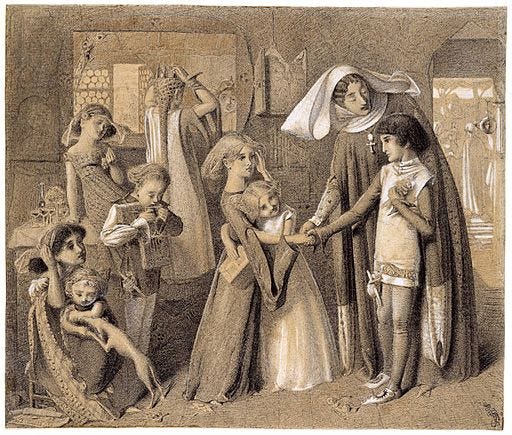
Dante first met Bice when he was 9 and she was 8, or so he tells us. In fact, they were neighbors, and I have a hard time believing that the three encounters with Bice that Dante writes about were the only ones that occurred, though it’s entirely possible that they only spoke to one another on those occasions.
Dante was immediately smitten. He claims he was overcome with love at the sight of the young Bice, who was dressed in a simple gown of a modest and decorous crimson. He doesn’t mention any reciprocal smittenness on Bice’s part.
Dante details a couple of later meetings with the adult Bice, one where she thrills him by actually greeting him, and another where she plunges him into the depths of despair by withholding her greeting. Courtly love involved a lot of emotional highs and lows, and Dante rode them like a true rollercoaster aficionado.
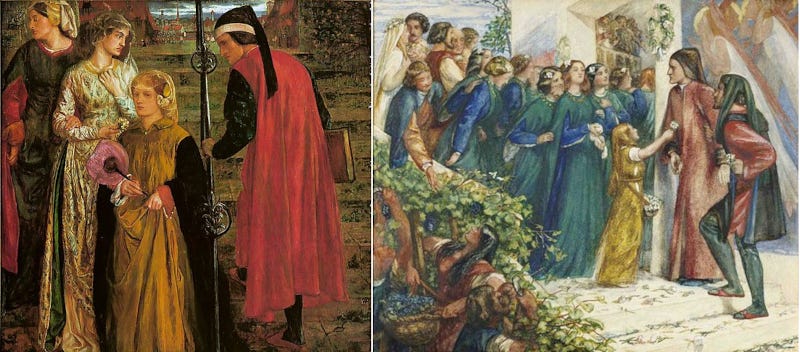
Bice married Simone dei Bardi, called Mone, a wealthy knight from another powerful banking family. We don’t know when they wed, but it could have been when she was quite young. In fact, she was probably a married woman during most of the years of Dante’s flamboyant adoration. The marriage was likely a business and/or political affiliation, and not a love match. We don’t know if she bore any children, though given her age at death (24 or 25), many have speculated that she might have died in childbirth.
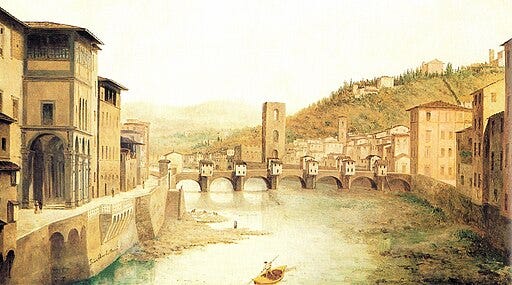
The Bardi family lived in the Oltrarno section of Florence (across the River Arno from the religious and political heart of the city), near the Rubaconte Bridge, now the Ponte alle Grazie. In the political clashes that roiled Florence in those years, the Bardi allied themselves with the Donati; Bice’s brother-in-law Cecchino was part of Corso Donati’s entourage during a famous altercation with Dante’s first friend, Guido Cavalcanti. (For this incident and more about Guido, see this earlier post.) Dante was no fan of Corso’s politics, though he himself was married to a Donati.
After Beatrice’s death in June 1290, Simone married again. Some say we don’t know who he married (there’s that “don’t know” part again), but at least one biographer, Alessandro Barbero, tells us that he wed a sister of the knight Musciatto Franzesi, who was a financier of Charles of Valois, who would one day crush the Cerchi (anti-Donati) faction. Italian Wiki, however, says he married Bilia (Sibilia) di Puccio Deciaioli. Simone did have at least three children, one of whom married into the Medici family, but we don’t know whether Bice was the mother of any of them or not.
The parish church Bice and Dante both attended, Chiesa di Santa Margherita dei Cerchi, claims that she is buried there with other members of her family, who were among the wealthy patrons of the church. But many scholars think it more likely that she was interred with her husband’s family instead. Nevertheless, suffering lovers leave little notes of petition to her at Santa Margherita.
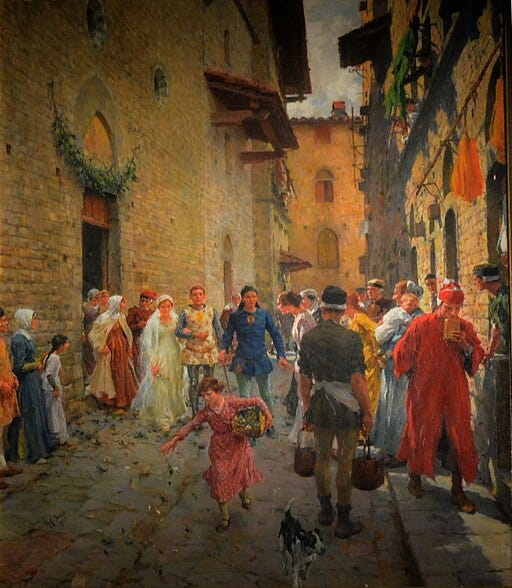
Dante tells us that all of Florence mourned her passing. He informs us of his desire “to write of her what has never been written of any other woman,” and with his great poem, he succeeds.
He describes her as having ineffable courtesy. She destroys all vices and is the queen of virtue. She is kind and blessed, radiant, comforting, gracious, and—being the bearer of blessings—well named.
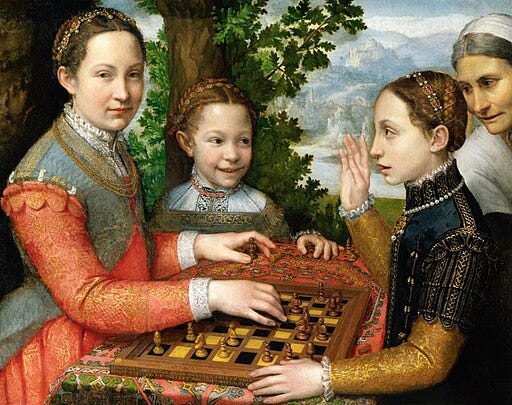
Thanks to Dante, Bice’s fame lives on. She fired the imaginations of countless artists—the pictures here are only a small sample—and has even been known to appear in video games and outer space (Asteroid 83 Beatrix is named for her).

But none of this tells us anything about Beatrice as a person. She lived a brief quarter of a century, in Florence, in the 13th century, born to a wealthy family and married into another. We don’t know which of her many siblings she was closest to, or how she spent her days, or whether she was literate (and if so, whether she could both read and write or only read), or what she was good at, took pride in, looked forward to, dreaded, thought was boring. What were her daily responsibilities? Did she sing, or play an instrument? Who were her friends? What were her thoughts on politics, on religion, on anything? We don’t, and can’t, know.
I’ve thought about writing a novel that would involve Bice. It would be primarily about Gemma Donati, Dante’s wife, who grew up in the same neighborhood as Dante and Bice and who Dante never wrote a word about. But it isn’t possible to tell Gemma’s story without Bice, so you would find them both there, along with the poet himself.
Is my Bice ineffable? No. My characters tend to be pretty effable, and Bice will be no exception. She’s rich, kind, pretty, as one would expect. She’s also nearsighted, absent-minded, a little eccentric, and a fabulous chess player.
Why is my Bice-character all those things? I have no idea. That’s how she presented herself to my imagination. I liked her that way, so I decided to run with it. That’s a lot of the fun of writing historical fiction!
And who’s to say that this beatitude-bearing lady wasn’t a chess hotshot?
This post is an updated version of something I wrote a number of years ago. That may be true of several upcoming posts, too, as I am entering a busy period and may not have time to write new posts every two weeks for a little while. This may mean that some of my material will feel familiar to anyone who has followed my various communication efforts for a long time (blog, Facebook page, both no longer functioning). But that won’t be true for most of you, so I hope the upcoming posts will feel fresh. I’ll still be available for conversations and comments, of course, and I’ll be back to original posts soon.
Thank you for reading Medieval Italian People. Be well, and I’ll be back with something (maybe something old, or something new, or something borrowed - but only from my former self - or, who knows, even something blue) in a couple of weeks.