Bom dia!

Fair warning - this may not be my most organized post ever. We’re just back from three and a half weeks in Portugal, and I’m (1) still jetlagged, (2) coming down with a cold, and (3) so overwhelmed with all we saw on the trip that I don’t know where to start.
Plus, my husband took 3300 pictures. Do you know how mind-numbing it is to try to go through 3300 pictures?!? He spent the whole trip with both a Canon mirrorless R10 and a Nikon digital SLR around his neck, happily using first one, then the other. Apparently it’s liberating not to have to stop and change lenses every time a new subject looms into view. I personally favor a point-and-shoot technique: I point Tim at something and say, “I need a photo of that thingie over there, with as much detail as you can get on the left-hand panel, please,” and he makes it happen.
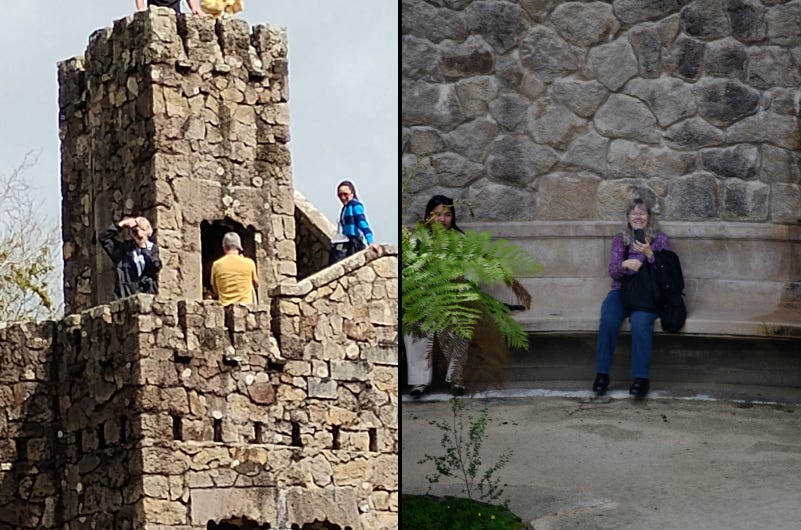
Here are shots taken in Sintra of me taking a picture of Tim taking a picture of me taking a picture of him… you get the idea:
You may be wondering what Portugal has to do with medieval Italians. I was wondering that too, a bit, but I did manage to find a few connections. The first thing I looked for was the medieval part.
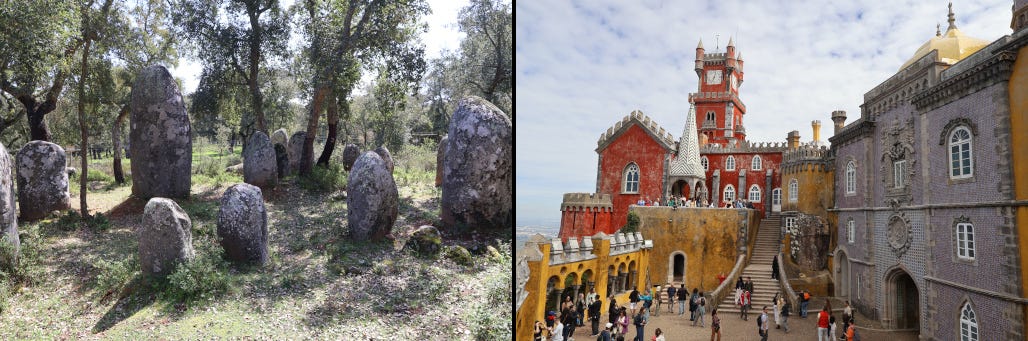
And it was there. Although Portugal’s heyday was the Age of Discovery, well past the medieval period, there are plenty of reminders, including castles, and also churches built in the 12th century on the sites of earlier Moorish mosques, which in turn were built on the sites of Visigothic Christian chapels. A veritable layer cake of medieval.
While the search for medieval was immediately rewarding, looking for something Italian was a bit trickier. We did encounter the work of an Italian architect called Nicolau Nasoni (1691-1773), a Tuscan by birth, who worked first in his native Italy, then in Malta, and finally in Portugal. Wikipedia raises an interesting question as to how Nasoni wound up in Portugal: “His time in Malta was cut short due to unspecified legal or financial troubles, leading to his swift and necessary departure for Portugal.” Doesn’t that make you curious? It certainly intrigues me.
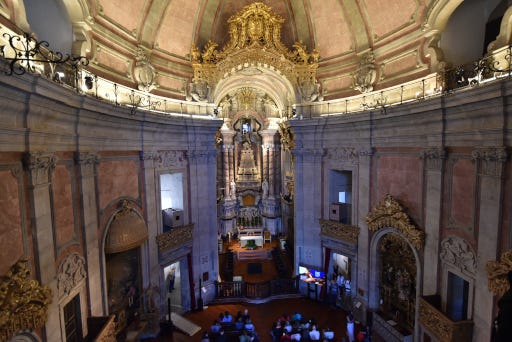
In any case, once in Portugal (Porto, specifically) he baroqued everything half to death, spewing cherubs and garlands and towers and gilt and glitz all over the place. The Clérigos Church is his tour de force, and he’s believed to be buried there, maybe under the wedding cake thing up in front.
But, you may ask, did you find anything that was both medieval AND Italian?
Why, yes. I did. If there’s any such thing around, I will usually manage to ferret it out. In this case, it was Saint Anthony of Padua, who also happens to be Saint Anthony of Lisbon. He was born in Lisbon, christened Fernando Martins de Bulhões, and at 15 he joined the Canons Regular of the Holy Cross in Lisbon, and at 17 he went to Coimbra, where he studied Latin and theology. After being ordained, he joined the Franciscans, only 11 years after the founding of the order, and he came to know Francis of Assisi personally. He was profoundly affected by the fate of the five Moroccan Martyrs, the first Franciscan martyrs, to the extent that he later traveled to Morocco, though his poor health meant he had to return to Portugal. However, his ship was pushed off course and he wound up in Sicily, then later in Tuscany and other points in Italy.
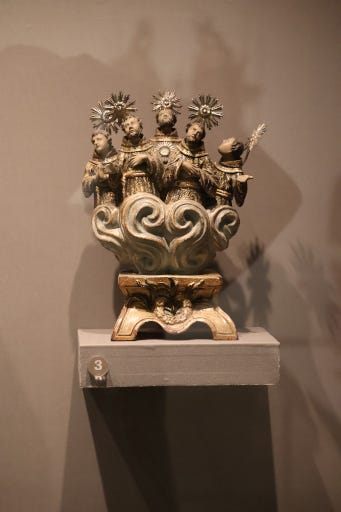
Incidentally, those five martyrs figure in my second novel, Lady of the Seven Suns. The Portuguese king Afonso II ransomed the martyrs’ bodies and had them brought back to Portugal; one of the several reliquaries we saw with their remains is pictured here:
Our itinerary: Lisbon, Sintra, Évora, Coimbra, Porto, Nazaré (with a day trip to Alcobaça). This gave us a taste of several different regions. One disappointment was that no fewer than four museums (and one church) on my must-see list managed to be closed for renovations - one of the downsides of traveling in the off season, I guess. Still, we found no shortage of things to explore.
A few favorites:
We took a tour of megalithic sites near Évora with an archaeologist who really knows her material. It was just the two of us and her, and it was great - she’s so into what she does that it’s fascinating to hear her speculate on how many uses early peoples must have found for cork, for example. Cork isn’t a material that survives the centuries, but as she pointed out, they would have seen its durability, light weight, hydrophobic qualities, fire resistance, and insulating properties, and certainly would have made use of such a remarkable material. We saw cork trees resting in between harvests, and learned a bit about the cork industry.
In Coimbra, the ancient university (founded in 1290) with its black-caped students (selling postcards to finance an end-of-year parade) was interesting, and redolent of centuries of rich history. The library of King João (and its resident bats, who eat the insects which would otherwise eat the books) was quite a sight.
In Porto we met a writer friend who I only knew online before this visit. That was a highlight, and we learned a lot about Portugal from our conversation. (Hi, Mike! Hi, Ted!)
We spent Easter in Nazaré. I was expecting a small fishing village, but I had failed to take into account the Easter holiday and the fact that Nazaré is also a resort town. It was mobbed. I think everybody in Spain had made a beeline for the coast. We saw traditional folk dancing and parades. The ladies of Nazaré are known for their skirts with seven petticoats, which tends to make them look a bit like bell jars, and their dancing partners are distinguished by clashing plaids - one plaid for the shirt and another for their pants. The women are also wearing several unrelated prints: skirt, top, apron, and possibly kerchief. The bell jar ladies were all over town, selling things, offering rooms to rent, and so on. We spent two days in the mobbed town, and then everyone magically vanished, back to the workaday world, and we had two more days in a small fishing village. And we never moved at all.
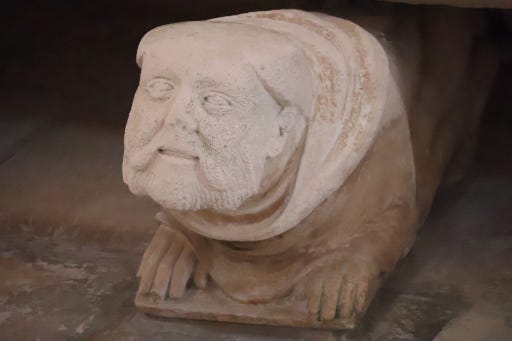
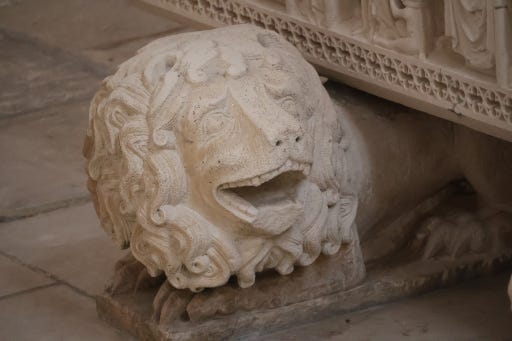
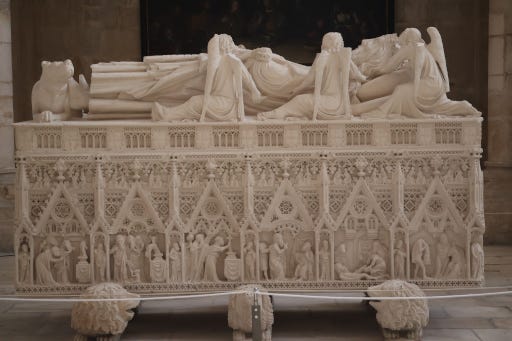
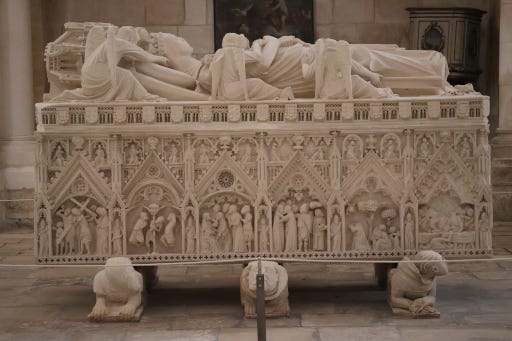
And last but not least, in Alcobaça we visited the Monastery of Santa Maria and saw the tombs of Portugal’s most famous tragic and romantic couple, Pedro and Ines. Here’s a link to a retelling of their story: https://www.portugalthings.com/the-story-and-legend-of-pedro-and-ines/
There’s so much more I could say about our trip, but I’m running out of time, space, and energy. We loved Portugal and hope to go back (and probably take another 3300 pictures).
If you’re looking for some good reading, especially in the area of historical fiction, consider some of the books you’ll find in this promo. My two books are there, and you’ll see many others of interest, set in lots of different times and places. You’ll note two by my friend and critique partner Kim Rendfeld, who will be doing a guest post here on Medieval Italian People in a couple of weeks. Kim writes about an earlier medieval period than I do, and she’s the author you want if you’re intrigued by Franks, Carolingians, Saxons, Merovingians, and others of that early medieval period. Just click on the picture to see all the books being featured.

Kim and I will see you in couple of weeks. Meanwhile, if you’d like to take a look at her Substack. you can find it here: