
Siena made me...

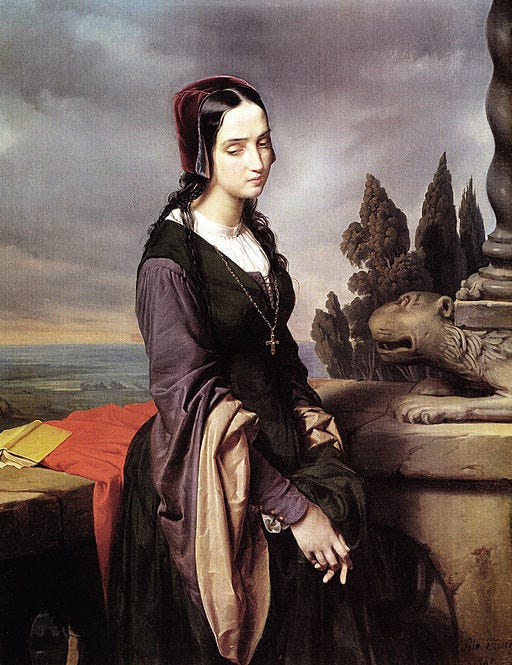
Happy December, everyone. It’s been a busy time, so I wanted to pick something quick and easy for this post. Hmm, I said to myself – how about Pia de’ Tolomei? She gets a brief mention in Dante’s Purgatorio, so there’ll be lots of background stuff about her in all the Dante commentaries. Easy, right?
Wrong. There’s a reason I’ve adopted the motto “Not that simple.”
With Pia, there are at least three different women of that name who might be the one we’re looking for. She might have been a virginal young girl, or she might have been previously married and the mother of two sons. She might have been married to Nello, or she might have been married by Nello to someone else (a proxy might have been involved). Or she might have been betrothed but not married. Or she might have been someone’s unfaithful wife, sent to Nello to deal with in his capacity as judge and head honcho. She was killed (if she was killed) so that Nello could marry Margherita degli Aldobrandeschi, or as punishment for her infidelity, or because Nello became jealous, or because she did not produce sons, or because Nello’s brother Ghino framed her when she rejected his advances. And all of this happened around 1290, unless it was earlier. Or later.
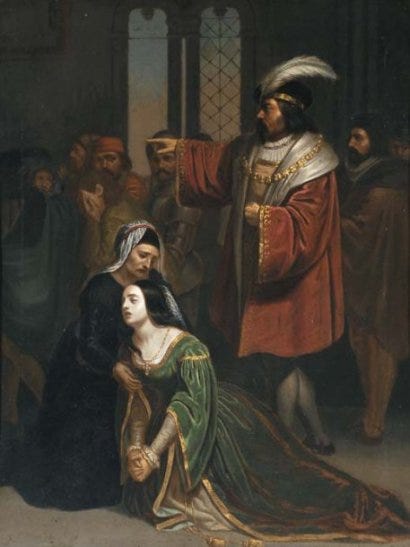
It’s either a multiple-choice exam with no answers, or a choose-your-own-adventure book. And every choice you make limits the others. So let’s begin with what we think we know (until we make the fatal mistake of actually digging into the details):
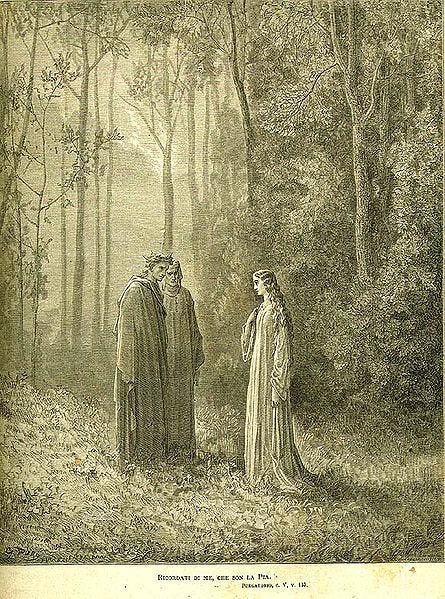
Pia de’ Tolomei is a Sienese noblewoman, and Dante encounters her shade in his Purgatorio where she gives us a taste of her story: “Remember me, for I am Pia – Siena made me, Maremma unmade me. He knows, that one who first gave me his ring.” She also endears herself to Dante’s readers by expressing concern for the poet: “When you are returned to the world and rested from your long journey…”
The commentaries: Pia was married to Nello d’Inghiramo Pannocchieschi, a powerful lord of the Maremma region south of Siena. Nello had a longstanding relationship with Margherita degli Aldobrandeschi, who he hoped to marry (in between her various other marriages, but that’s another story), so he killed Pia (or had her killed) by throwing her (1) over a cliff or (2) out a tower window, or (3) strangling her, or (4) poisoning her. Some also say that her death was accidental, or that she died of malaria.
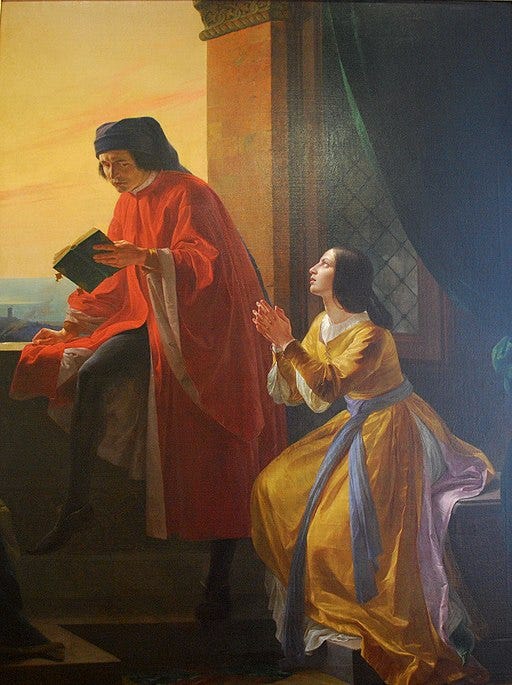
Note that Dante does not specifically mention Nello or accuse him of anything. Dante at this point was exiled from Florence, traveling around Italy as the guest of various noblemen, and he probably wouldn’t have wanted to antagonize someone capable of defenestrating women.
Nello’s family is well documented, and there’s no mention of his marriage to Pia de’ Tolomei. She’s not mentioned in the Tolomei family, either. Could she have been Pia Malavolti, daughter of another powerful Sienese family, whose first marriage was to Tollo (or Bertoldo) di Prata, who died in 1285? Or was she Pia Guastelloni, daughter of Buonconte Guastelloni and wife of Baldo d’Aldobrandino Tolomei, who died in 1290? Probably not that last, because that Pia was alive in 1318.
And there are two guys named Nello Pannocchieschi. Inghiramo’s son is the more famous of the two kinsmen and the one involved with Margherita, but Nello di Mangiante is thought by some to have been Pia’s spouse. However, probably since it’s nearly impossible to find out anything about the latter, most historians have agreed to ascribe Pia’s demise to the first. Also he was in charge of the right castle, the one in Pia’s legend.
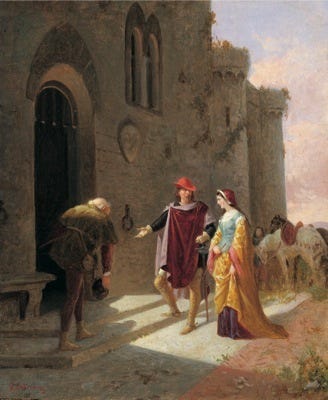
Was Pia even married to Nello? Maybe, but I’ve seen speculation that (1) he was taking part in a marriage-by-proxy and she was actually marrying somebody else, or (2) as lord of the area, he had brokered the marriage and had a role in the ring-giving ceremony.
And if she was married to Nello, how long were they together? Some say she had two sons by a previous marriage, but others say the sons were Nello’s.
Some say that Pia did not produce sons for Nello, and that was his excuse for asking her to agree to an annulment. Pia refused, and that precipitated her murder, because Nello was determined to get his hands on Margherita. I’m not convinced Pia could have stopped him if he really wanted an annulment.
Nello’s will, filed in 1322, mentioned two wives, neither of which was Pia. Then again, he also didn’t mention Margherita, and he did manage to marry her eventually, not that that marriage went particularly well either.
There are people who believe that Pia was an unfaithful wife to someone who owed allegiance to Nello, and she was handed over to him for punishment. (If she was in fact Pia Malavolti, she was said to have had “many lovers.”)
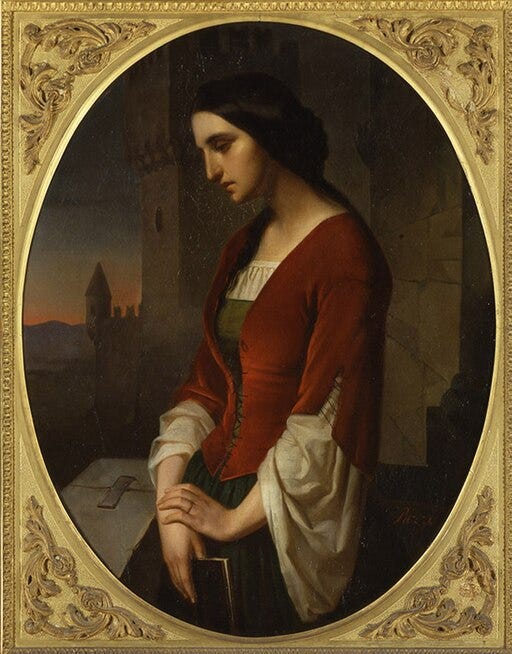
Remember too that this was a time of explosive conflict between the Guelfs and the Ghibellines, and the Tolomei, the Aldobrandeschi, and the Pannocchieschi were all involved up to their collective eyebrows. Alliances tended to shift and change with alarming rapidity, and the great families were constantly jockeying for power. There may well have been reasons for Pia’s demise that had nothing to do with her personal situation, whatever it was. And most, if not all, of the marriages mentioned here would have been political in nature, either forging alliances or attempting to defuse hostilities.
So I don’t have any answers for you. I wish I did, but there are just too many loose ends, too many crucial bits of information missing. That’s how it always is in this period. It’s both challenge and opportunity for a fiction writer, but in an ideal world, one would at least have some idea of what actually happened.
Not. That. Simple.
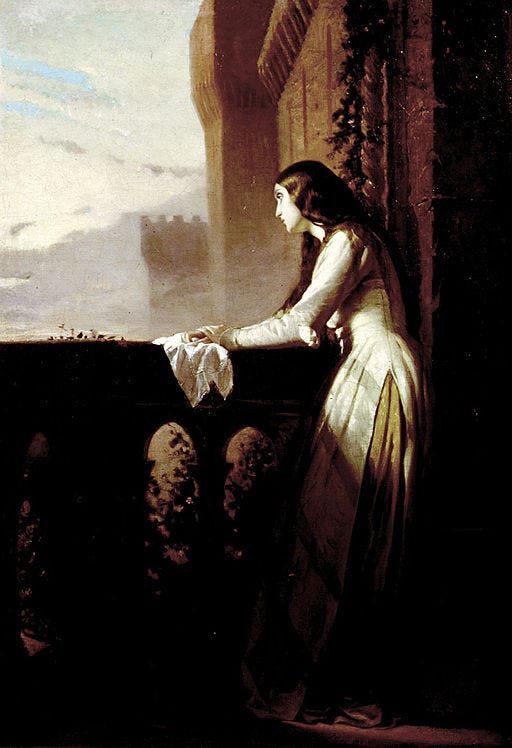
Gaetano Donizetti wrote an opera about Pia in 1836, and he ran into almost as many problems as Pia herself did. First, the opera was to have its premiere in Venice’s famous opera house La Fenice, but when Donizetti was traveling to Venice he was delayed in Genoa due to a cholera epidemic. While there, he learned that La Fenice had burned down on 12 December. His production was canceled, and with it most of his fee. He proceeded to Venice as soon as possible anyway, and negotiated a new premiere in a different theatre. That performance was unfortunately delayed when the bass singing Nello became ill and Donizetti had to rewrite the part for a baritone. The opera was only a partial success, and Donizetti rewrote it - twice. And to add to his woes, he was only allowed to present it in Naples when he promised that Pia would not die at the end. Donizetti must have been ready to defenestrate somebody himself by then. If you’d like to hear a taste of it, here’s a link to Pia’s Act 2 area “In questa de’viventi orrida tomba,” which doesn’t sound any more cheerful than you would expect:
That’s it for the ides of December. I’ll be back with something holiday-related later in the month, and I wish you all happy holidays, whatever and however you celebrate.