
These blessed wet nurses

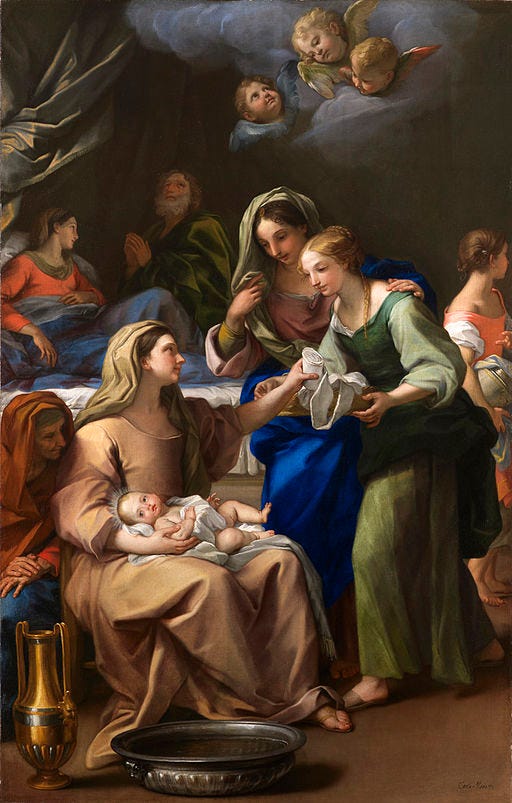
Here is my promised post on Margherita Datini’s heroic effort to track down wet nurses on behalf of her friends, her husband’s business partners and customers, and anyone else in need of such services. If you missed my earlier post of more general information about wet nurses, you’ll find it here:
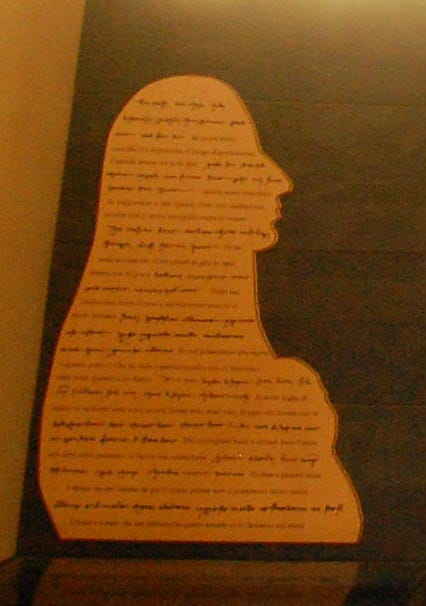
This time, I want to introduce you to Margherita. Born into a noble-but-disgraced Florentine family in 1360, she became the wife of the wealthy Francesco Datini, known to history as the Merchant of Prato. Though unable to bear children herself, she nevertheless found herself in the position of searching for, interviewing, and hiring wet nurses to feed other womens’ infants on many occasions over the years. This aided her husband by helping out his business associates in need of such services for their offspring.
Who were these nurses? For the most part, they were wives of her husband’s employees, or women she knew in the neighborhoods of the Datini homes in Florence and nearby Prato—women who had milk available and wanted to make a little extra money. Margherita had a network of women friends, family members, and neighbors who helped her in her searches, and she needed their help, for when an infant appeared on the scene and a wet nurse was needed, there was no time to lose.
Margherita had plenty of advice available. The Trotula books from Salerno (a story for another time) advised that the wet nurse should be young, of good color, not blemished, with an ample chest, and a little bit fat. The physician Aldobrandino of Siena stipulates that the child that had been born to the nurse—the child that milk was meant for—should have been a boy, especially if the nursling was a boy. It was no good, he said, to give “girl’s milk” to a boy child, for it would make him effeminate. He also suggests someone who is cheerful, good-tempered, and who will not terrify the child. (That last one does sound pretty important.) The nurse’s diet was to be carefully controlled, avoiding spices, onion, anything pungent, and most of all eschewing garlic. There were many other instructions in circulation, some contradicting each other, but overriding everything was that when a nurse was needed, she was needed Right Now. The infant was not going to wait patiently for its feeding. Thus, sometimes a compromise was in order, even if only for a short time.
Because Margherita and Francesco were often in different locations due to his business responsibilities, a vast trove of letters between them exists. I’ve gone to Margherita’s letters, translated by Carolyn James and Antonio Pagliaro in their wonderful Letters to Francesco Datini, to bring you the lady’s own comments about this responsibility.
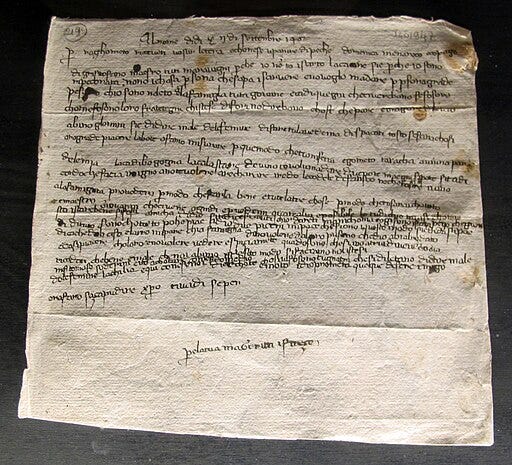
Here are Margherita’s words when she found one she liked:
“I would advise him not to let this girl go because she is the daughter of a rich and respectable artisan … As a wet nurse she couldn’t be better. She has all the qualities that make an excellent nurse … she has had her milk for only two months. She could feed any baby with no trouble at all.”
But it was not always thus. “The woman is old and the milk too abundant, despite the fact that she says she has very little. So tell him to look in Prato …” And this: “I asked Stefano d’Arrigo’s daughter … why she had taken her daughter away from the woman. She says that the longer the baby stayed in her care, the unhealthier she became. She also says she only has one eye …”
Sometimes the problem was situational: “ … if it were my baby, I would only give it to her with the intention of taking it away as soon as a wet nurse with fresh milk came along, because I could never believe that when a wet nurse had her own one-year-old child she wouldn’t be feeding it as well. One hears such things all the time.”
Or the issues had to do with availability: “I found another above the piazza of the parish church who has had fresh milk for two months. I am told she is a good wet nurse; and she promised that if her dying baby succumbs tonight, she will come as soon as it is buried.” It is not clear whether the dying baby is the woman’s own child, or her current nursling. And this one: “It seems that the world has come to an end because I can’t find anyone. I had some women available whose children were about to die, but they recovered.” I can’t help wondering about the tone of that last one; is there sympathy there, or just irritation?
Margherita also had to handle complex arrangements to bring wet nurse and baby together with minimal delay, and probably with stopgap nursing in transit: “She doesn’t want to come to Florence to get the baby. Rather, I need to find a woman to collect it, if you decide you want to send me the baby in this way.” And this: “I am sending you the woman whom I wrote about in the letter delivered by Argomento. As I explained, this is not the woman who is to breastfeed the baby, but I am sending her to collect him because she has milk. I am also sending Colomba to carry the baby back here because otherwise the nurse would not travel comfortably.” And this: “I have engaged the woman who will care for the baby until I can provide someone really suitable. Send him early this evening so that it is not too hot and they can rest on the way and carry him in comfort. You can send him at a good hour, as soon as the heat has passed.” (They were walking, as there was no donkey available.)
Margherita even sometimes had to deal with the wet nurse’s wet nurse—the woman feeding the child the wet nurse had handed over in order to be available to nurse someone else’s child. “The wet nurse who is looking after the child of Niccolo’s wet nurse came for the money she is owed. I told her to come back on Saturday, and I said I would tell Niccolo and when I had heard his reply, we would give her the amount he told us.”
And how did Margherita view all this responsibility? There are hints: “Today I turned the whole world upside down to find a wet nurse, and to have a good few from whom to choose.” And this: “If you only knew the effort that it has cost me, as well as my friends, to search for these blessed wet nurses. When they bring them to see me, I have to find out about their health and circumstances, and the more you look the more problems you find. It is not as easy to find them as people think, if you want someone really good.” And, finally, this: “May God allow me to gain honor from this matter, which I wish I had never taken on because one could come out of this business covered with shame rather than honor considering all the things that could go wrong, but I will do my part and may God do the rest.”
Reading Margherita’s letters, one gets to know her a little, and I think it’s safe to say that she did indeed do her part, in this and in many more matters.


I’ll be back with more about my beloved medieval Italians later in the month. Until then, be well, read great books, and stay warm.
This was very interesting. I'll have to tell my daughter about this because she does medical staffing and I'd like to hear what she thinks about these challenges. 😆.